















WebSocket Protocol Vs HTTP: Differences, Use Cases, And Tips

KEY TAKEWAYS:
- WebSocket protocol vs HTTP is a connection-pattern decision, not a simple speed contest. HTTP is request-response by default, while WebSocket keeps a persistent full-duplex connection for real-time messages.
- WebSocket still starts through HTTP infrastructure. The browser opens an HTTP request, asks for an upgrade, and then switches to the WebSocket protocol when the server accepts the handshake.
- Use WebSocket for chat, live dashboards, multiplayer features, collaborative editing, trading interfaces, and telemetry streams where low-latency two-way updates matter.
- Use HTTP for documents, search, checkout, caching, SEO pages, webhooks, APIs, and workflows where stateless requests, intermediaries, retries, and cache control are more valuable.
- Production real-time features and web application security controls need more than protocol selection: teams must plan authentication, scaling, load balancing, backpressure, monitoring, fallbacks, and operational ownership.
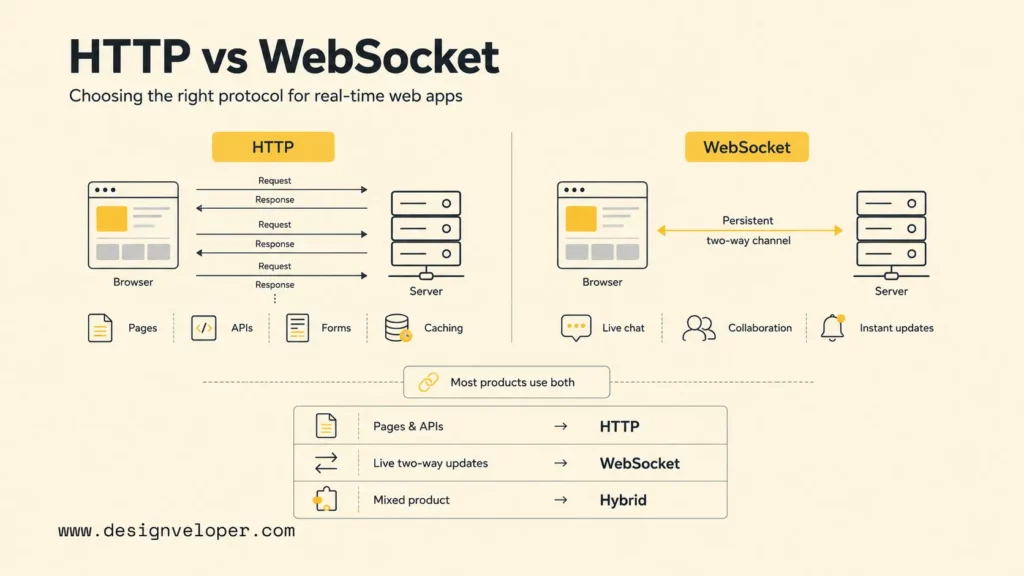
WebSocket protocol vs HTTP is not a contest with one universal winner. HTTP is the dependable default for request-response work, cacheable resources, REST APIs, forms, and search-friendly pages. WebSocket is the stronger fit when a browser and server must keep a live, two-way channel open for frequent, time-sensitive updates. Most modern products use both: HTTP establishes the application and handles conventional operations, while WebSocket powers selected real-time interactions.
Quick decision guide:
| Requirement | Better Starting Point | Reason |
|---|---|---|
| Pages, assets, forms, or standard APIs | HTTP | Simple request-response semantics, broad tooling, and native caching |
| Frequent two-way updates with low delay | WebSocket | One persistent connection carries messages in both directions |
| Mostly one-way server updates | HTTP streaming or Server-Sent Events | A simpler model may satisfy the requirement without a full-duplex channel |
| A feature-rich web product | Hybrid | HTTP handles conventional flows while WebSocket handles real-time events |
The practical decision depends on message direction, frequency, state, failure handling, infrastructure, and the user experience you need to protect. This guide explains those tradeoffs without treating either protocol as automatically faster or more modern.
Further reading:
- Web App vs Website: Similarities, Differences and Misconceptions
- Web App Development Cost: Breakdown
- 20 Web App Ideas: Health, FinTech, AI, E-commerce
What Are HTTP And WebSocket?
HTTP is a stateless application-level request-response protocol family. A client sends a request containing a method, target, headers, and sometimes a body. A server returns a response with a status code, headers, and often a representation such as HTML or JSON. That familiar exchange supports websites, APIs, file delivery, authentication flows, form submissions, and much of the public web.
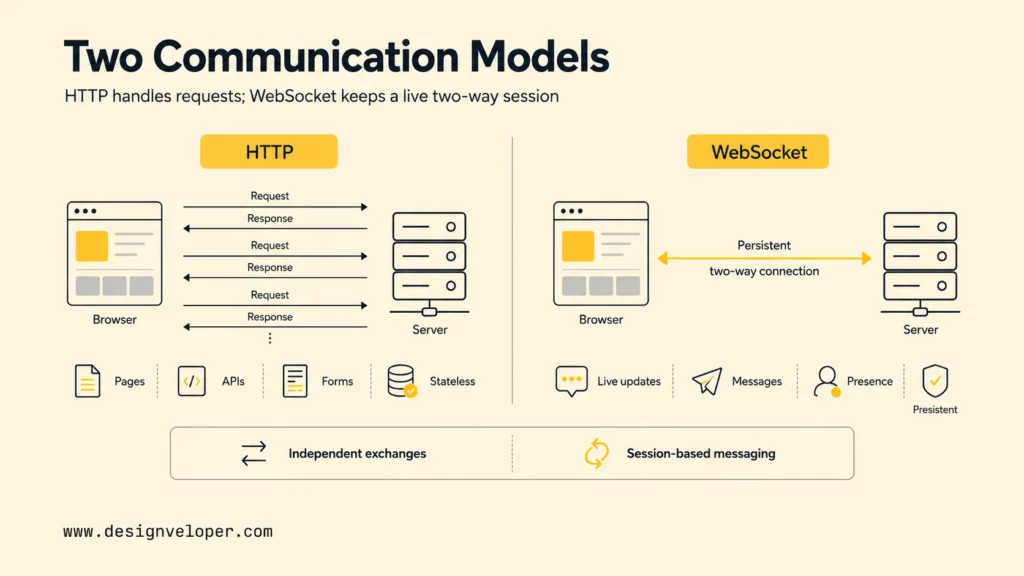
HTTP/1.1, HTTP/2, and HTTP/3 use different transport and connection techniques, but they share the core semantics defined by the current HTTP specification. HTTP/2 multiplexes several streams on one connection, while HTTP/3 uses QUIC and avoids some transport-level head-of-line blocking. These advances make modern HTTP far more efficient than the old mental model of opening a new TCP connection for every resource. They do not, however, turn a normal HTTP exchange into a general-purpose, full-duplex messaging session.
WebSocket is a protocol for two-way communication over a persistent connection. After an opening handshake, either endpoint can send framed messages when it has data, without waiting for a new request-response cycle for each event. That model is useful when a server must push unpredictable updates and a client must also send frequent commands, presence changes, acknowledgements, or edits.
A WebSocket connection normally begins through an HTTP-based handshake, but the application does not continue exchanging ordinary HTTP requests after the switch. It communicates using WebSocket frames. The browser API exposes this as a long-lived object with open, message, error, and close events. Secure deployments use wss://, which protects the connection with TLS in the same broad way that HTTPS protects HTTP traffic.
The distinction is architectural: HTTP organizes work as independent exchanges, while WebSocket organizes work as a session. HTTP therefore makes it natural to reason about URLs, methods, status codes, caching, and retries. WebSocket makes it natural to reason about connections, channels, messages, ordering, subscriptions, and connection state.
Choose a protocol for the interaction pattern you actually have, not for the word “real-time” on a feature list.
WebSocket Vs HTTP: Key Differences
The most important differences appear after the connection is established. The following comparison focuses on operational impact rather than protocol trivia.
Recommended for you:
- Guide about Web Application Development for Beginners
- Web Application Development Tutorial: The Ultimate Guide for Beginners
- 10 Best Web App Languages
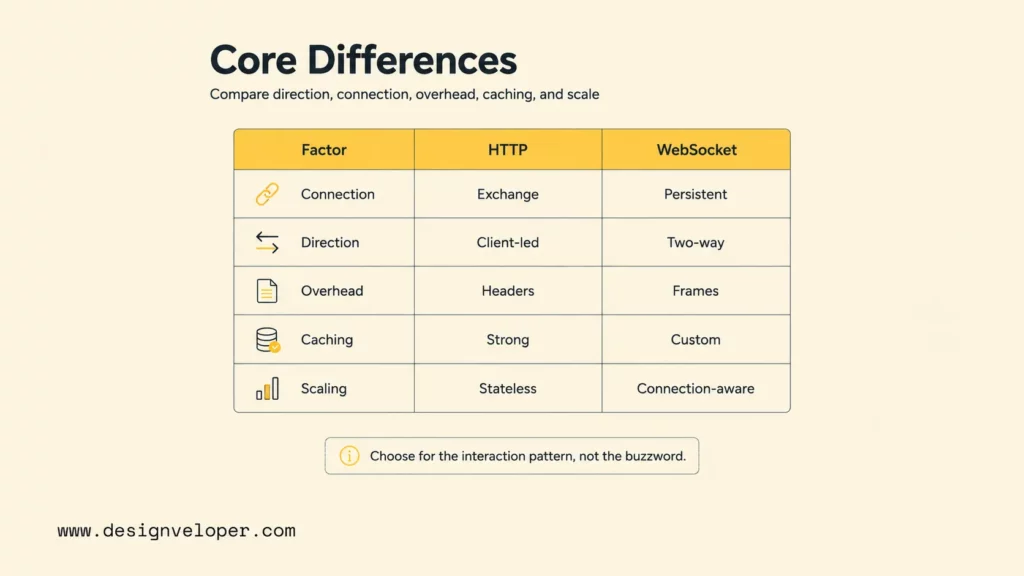
| Factor | HTTP | WebSocket | Practical Impact |
|---|---|---|---|
| Connection model | Request-response exchanges over reusable or multiplexed connections | One long-lived messaging connection | WebSocket servers must track connection state and lifecycle |
| Communication direction | Client initiates standard requests; responses and streaming follow that exchange | Either endpoint can send messages after connection | WebSocket suits unpredictable, bidirectional events |
| Latency | Modern connection reuse is efficient, but each operation retains request-response semantics | Small frames can travel without repeating a full HTTP exchange | WebSocket can reduce overhead for frequent messages, but does not remove network delay |
| Overhead | Headers accompany requests and responses | Compact frames follow the initial handshake | Savings become meaningful with many small, frequent messages |
| Scalability | Stateless handlers are generally easy to distribute | Long-lived connections require connection-aware capacity and event distribution | WebSocket needs deliberate gateway, pub/sub, and draining strategies |
| Caching | Standard caches can reuse eligible responses | No general HTTP-style response cache for messages | WebSocket applications design snapshots, replay, and client state themselves |
| Security | Mature controls around HTTPS, methods, origins, intermediaries, and authorization | Uses TLS with WSS, but requires message-level authorization and origin validation | A secure handshake alone does not secure every channel or message |
| Debugging | Methods, URLs, status codes, logs, and command-line tools are widely understood | Requires frame inspection, connection IDs, close codes, and event correlation | Operational visibility needs more application-specific instrumentation |
Performance deserves careful language. A WebSocket is not automatically faster than HTTP for every operation. The opening handshake adds work, and a persistent connection consumes resources even when quiet. For an occasional settings update or a cached product page, HTTP is usually simpler and can be faster end to end. WebSocket gains an advantage when a product exchanges many small messages and would otherwise repeat headers, requests, polling intervals, or connection setup.
Direction also needs nuance. HTTP can deliver server-originated updates through long polling, streaming responses, or Server-Sent Events. Those options can be excellent when data primarily flows from server to client. WebSocket becomes especially compelling when both sides send independently and frequently, such as a collaborative editor where users transmit operations while receiving other participants’ changes.
Caching is one of HTTP’s largest structural advantages. HTTP cache rules can let browsers, CDNs, and shared intermediaries reuse responses, reduce transfers, and lower origin load. WebSocket messages do not participate in that response cache model. If a user reconnects and needs missed events, the application must provide its own durable event log, snapshot endpoint, sequence numbers, or resume token.
How WebSocket Uses HTTP Upgrade
In the classic HTTP/1.1 flow, a WebSocket client begins with an HTTP request that asks the server to change protocols. It includes Upgrade: websocket, Connection: Upgrade, a random Sec-WebSocket-Key, and a supported WebSocket version. A simplified handshake looks like this:
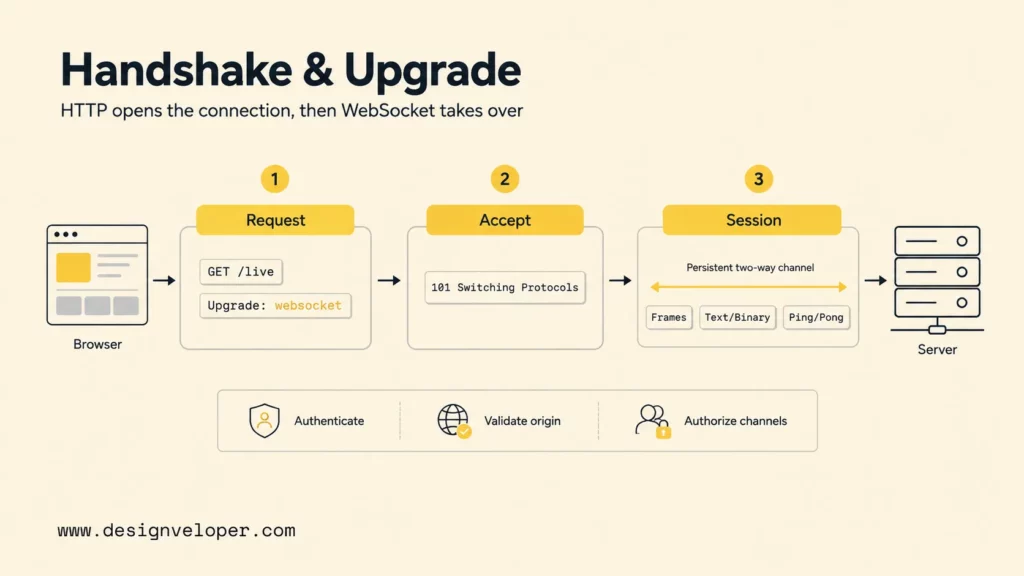
GET /live HTTP/1.1Host: example.comUpgrade: websocketConnection: UpgradeSec-WebSocket-Key: dGhlIHNhbXBsZSBub25jZQ==Sec-WebSocket-Version: 13If the server accepts, it returns 101 Switching Protocols, names WebSocket in the upgrade response, and proves that it received the client’s key by returning a calculated Sec-WebSocket-Accept value. At that point, the same underlying connection stops carrying ordinary HTTP messages and starts carrying WebSocket frames.
HTTP/1.1 101 Switching ProtocolsUpgrade: websocketConnection: UpgradeSec-WebSocket-Accept: calculated-valueThe MDN HTTP upgrade guide explains the HTTP/1.1 upgrade mechanism is the version most developers recognize, but it is not the only deployment path. HTTP/2 does not use the same Upgrade header mechanism. RFC 8441 defines Extended CONNECT for bootstrapping WebSocket over HTTP/2, and RFC 9220 adapts that approach for HTTP/3. Client, proxy, load balancer, CDN, and server support therefore matter when choosing a production path.
The handshake is also the moment to authenticate the connection, negotiate optional subprotocols, and validate browser origins. Yet connection authentication should not be confused with complete authorization. A connected user may still be permitted to join one room but not another, read one account but not another, or send some event types but not administrative commands. Each subscription and sensitive message needs an authorization decision.
Once connected, frames can contain text or binary data. Control frames support functions such as ping, pong, and close. Applications still have to define the meaning of their own messages, often with a JSON envelope containing a type, version, correlation ID, payload, and sequence number. That contract is as important as the transport protocol because it determines compatibility, validation, observability, and recovery.
When To Use WebSocket
Use WebSocket when updates are frequent, unpredictable, time-sensitive, and bidirectional enough that a persistent session creates a clear user or system benefit. The strongest candidates have several of these properties at once. A feature that merely refreshes once every few minutes probably does not need it.
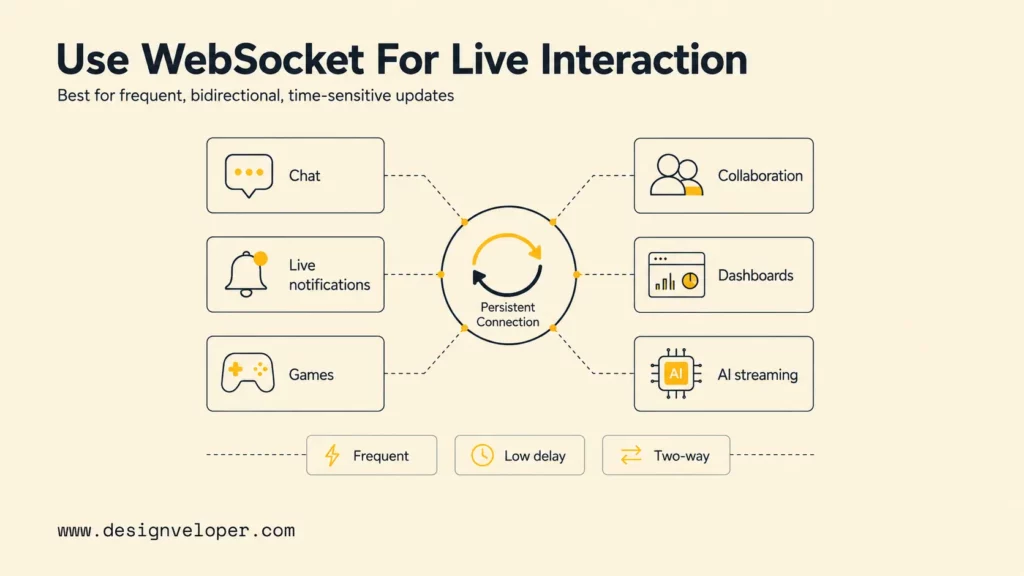
- Real-time chat: Users send messages, receive replies, see typing indicators, update presence, and get delivery acknowledgements without waiting for polling cycles.
- Live notifications: A server can immediately notify an active client about an assignment, alert, status change, or completed background job.
- Collaborative editing: Participants exchange cursor positions, presence signals, and document operations while the system resolves concurrent edits.
- Online games: Clients continually send player input and receive authoritative state updates where timing materially affects play.
- Live dashboards and trading feeds: The interface receives a continuous stream of changing measurements, prices, or operational events.
- IoT updates: Connected dashboards can receive device state and issue commands, provided the overall device and broker architecture supports the model.
- AI streaming and interactive assistants: A client can transmit control messages or live input while receiving tokens, tool progress, audio, or other incremental output.
Even within those categories, volume and direction decide the implementation. A simple notification feed may work well with Server-Sent Events because the browser mostly receives data. An AI answer that only streams text after one prompt can use an HTTP streaming response. A voice assistant that simultaneously receives audio, sends partial transcripts, handles interruptions, and updates tool state is a more natural WebSocket candidate.
Estimate the real message pattern before committing. Record expected concurrent connections, messages per second, average and maximum payload size, idle duration, burst size, geographic distribution, and tolerated recovery time. A design that works for 200 active internal users may need a different event backbone, connection gateway, and fanout strategy at 200,000 connections.
WebSocket is also appropriate when latency variance matters more than peak benchmark speed. Polling can produce uneven delay because an event waits for the next interval. A persistent connection lets the server send as soon as the event is available. The benefit is a more responsive interaction, not a guarantee that every packet will cross the network faster.
When HTTP Is The Better Choice
HTTP remains the better choice when work naturally fits independent operations, responses benefit from caching, or infrastructure simplicity carries more value than continuous messaging. It is the default starting point for most public-facing web features.
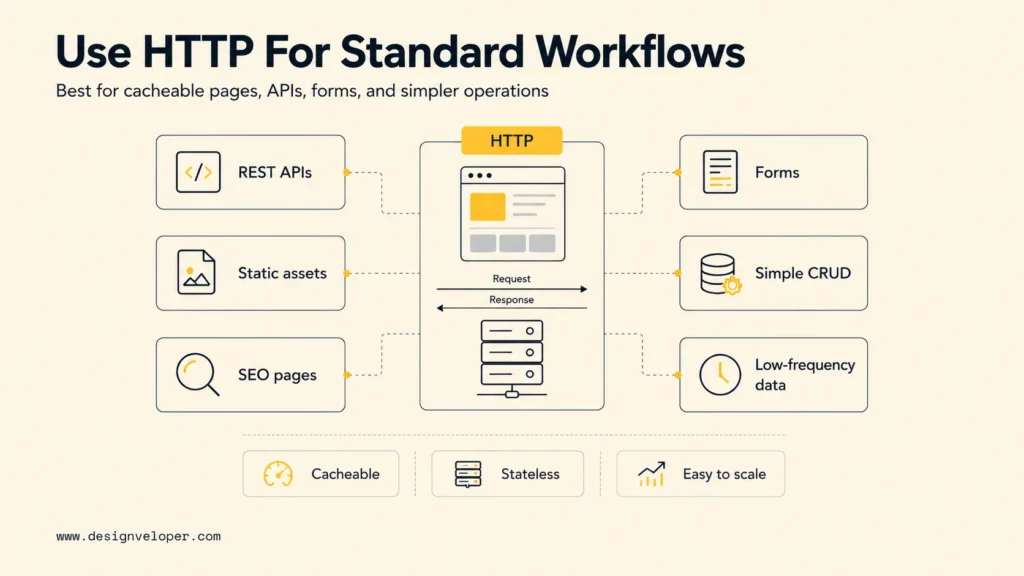
- REST APIs: Resource-oriented create, read, update, and delete operations map cleanly to methods, URLs, status codes, and conditional requests.
- Static pages and assets: HTML, CSS, JavaScript, images, and documents benefit from browser and CDN caching.
- SEO-indexable content: Search engines, link previews, accessibility tools, and ordinary navigation expect addressable HTTP resources and rendered page content.
- Form submissions: Registration, contact, checkout, and settings changes are discrete actions with clear success and error responses.
- Simple CRUD: Administrative dashboards often need reliable records and validation more than millisecond-level push updates.
- Cached or low-frequency requests: Data that changes infrequently does not justify a constantly open channel.
- Simpler retries, logging, and infrastructure: An idempotent HTTP operation can be traced, replayed, rate-limited, and scaled with widely available tools.
HTTP also provides stronger default boundaries. Each request can carry current authentication credentials and receive a specific status. Intermediaries understand request size, headers, methods, cache controls, and response codes. Teams can inspect traffic through familiar browser tools, API clients, access logs, and observability platforms. These qualities reduce operational cost.
For server-to-client updates, consider simpler HTTP-compatible patterns before choosing WebSocket. Long polling works nearly everywhere but repeats requests. Server-Sent Events maintains a text event stream with automatic browser reconnection and is well suited to one-way feeds. A streamed fetch response can deliver progressive results for a single operation. Each preserves more HTTP behavior while solving a narrower real-time problem.
Public pages should still arrive through HTTP even when they contain a real-time widget. The article, product detail, or landing page remains addressable and cacheable; JavaScript can then establish a WebSocket for presence, live inventory, support chat, or another interactive element. This separation supports both performance and web development.
A persistent connection is a capability, not a substitute for addressable resources, cacheable content, or clear API boundaries.
Choosing The Right Protocol For Your Web Application
Begin with the simplest model that meets the experience requirement, then validate it against traffic and failure conditions. The following matrix covers common product needs.
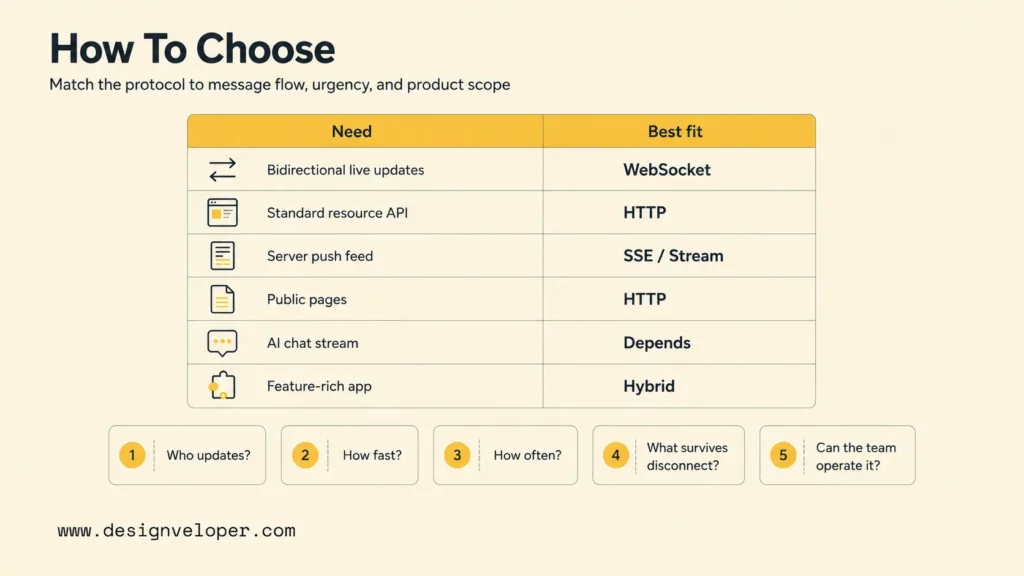
| Project Need | Better Choice | Why |
|---|---|---|
| Frequent bidirectional real-time interaction | WebSocket | Both endpoints can send over one persistent session |
| Standard resource API | HTTP | Methods, status codes, caching, and stateless scaling fit naturally |
| Primarily server push to a browser | Server-Sent Events or HTTP streaming | A one-way stream may be simpler to operate |
| Mobile application backend | HTTP by default; add WebSocket selectively | HTTP handles ordinary operations, while WebSocket can power active-session updates |
| SEO content and public pages | HTTP | Pages remain crawlable, shareable, cacheable, and addressable |
| AI or chat interface | Depends on direction | HTTP streaming works for one response stream; WebSocket helps with simultaneous input, output, and controls |
| Feature-rich product | Hybrid HTTP + WebSocket | Each protocol handles the interactions it models best |
A hybrid architecture is usually the most maintainable. The client might use HTTP to load the page, sign in, fetch an initial document snapshot, upload files, modify account settings, and retrieve history. It then opens a WebSocket to subscribe to live document changes and presence. If the connection drops, the client returns to an HTTP snapshot endpoint before resuming from a known sequence.
Ask five questions during design. First, who initiates updates? Second, how quickly must recipients see them? Third, how frequently do they occur? Fourth, what state must survive a disconnect? Fifth, can the team operate the resulting system? These questions often reveal that only one small feature needs WebSocket, while the rest should remain conventional HTTP.
Prototype with realistic traffic rather than relying on protocol benchmarks. Include TLS termination, authentication, serialization, database work, event distribution, and browser rendering. Measure end-to-end interaction time, reconnection behavior, memory per connection, queue depth, and user-visible staleness. A transport that looks efficient in isolation can still perform poorly when an application sends oversized payloads or rerenders too much data.
Infrastructure fit matters as well. A managed platform may support HTTP autoscaling but impose connection duration or concurrency limits. A reverse proxy may need explicit WebSocket settings. A CDN may support WebSocket pass-through without caching messages. Review these constraints early, especially during cloud application development, because they affect cost, topology, health checks, and deployment strategy.
Making Real-Time Features Work In Production
A successful demo proves that messages can move. A production system must prove that they remain secure, ordered enough for the domain, observable, and recoverable during network changes, deployments, traffic spikes, and partial failures.
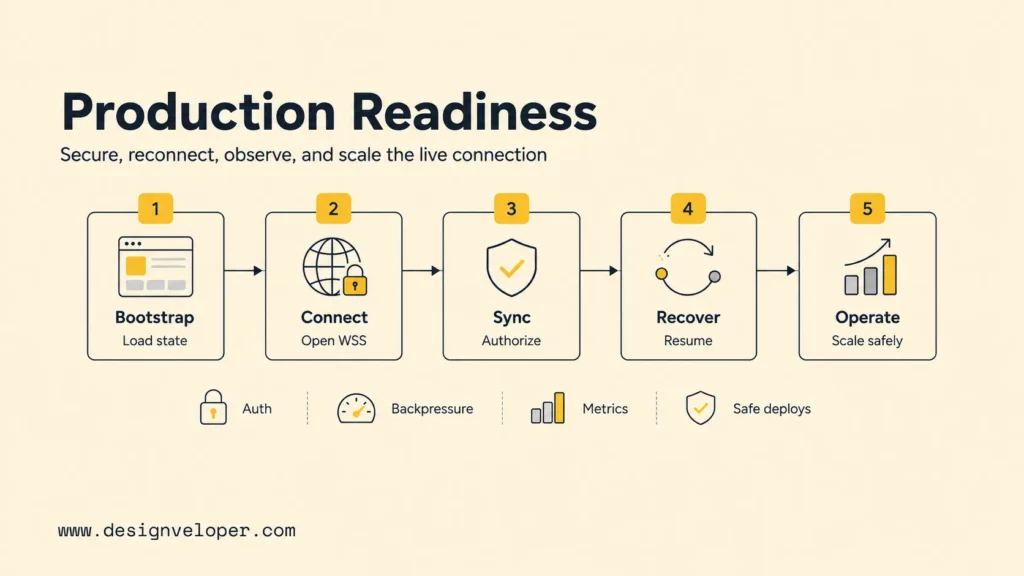
Production WebSocket Readiness Path
Load state and authenticate over HTTP
Open WSS and validate origin
Authorize channels and track sequence
Reconnect, resume, or reload snapshot
Limit, observe, scale, and drain safely
Authenticate the connection and authorize every action. Establish identity during the handshake using a secure mechanism appropriate to the platform. Avoid exposing long-lived secrets in URLs, where logs and analytics may capture them. Treat channel subscriptions and messages as application requests: validate their schema, confirm that the user may perform the action, and apply tenant boundaries. Recheck authorization when roles or sessions change.
Use TLS and validate browser origins. Production browser clients, JavaScript front ends, and Node.js services should use wss://. The WebSocket browser security model includes an Origin header, and servers should validate it against an allowlist to reduce cross-site WebSocket hijacking risk. Origin validation complements authentication; it does not replace it, and non-browser clients can set headers differently.
Design reconnection as a state machine. Mobile devices sleep, Wi-Fi changes, proxies expire idle connections, servers restart, and deployments drain instances. Clients should detect loss, wait with exponential backoff and jitter, refresh credentials when necessary, and stop retrying on permanent errors. The server can use ping and pong control frames or an application heartbeat to detect dead peers, but heartbeat intervals should reflect proxy behavior and operating cost.
Define ordering, duplication, and resume behavior. TCP preserves byte order within one live connection, but an application can still observe duplicates, gaps, or reordered business effects across reconnects, retries, workers, and external systems. Give important events stable IDs and sequence numbers. Make retryable commands idempotent where possible. Decide whether reconnecting clients replay missed events, fetch a fresh snapshot, or accept eventual convergence.
Control backpressure and abuse. The standard browser MDN WebSocket API documentation does not provide built-in backpressure. If messages arrive faster than code can process them, buffers can grow and consume memory or CPU. Use bounded queues, payload-size limits, per-user and per-connection rate limits, batching, coalescing, and explicit drop or disconnect policies. Validate every incoming message before expensive processing.
Instrument connections as first-class production entities. Track active and peak connections, handshake failures, authentication failures, reconnect rate, connection age, close codes, messages and bytes per second, event-to-screen latency, queue depth, dropped messages, fanout size, and subscriber lag. Attach connection IDs and correlation IDs to logs so an operator can trace a user action from an HTTP request through the event bus to one or more WebSocket recipients.
Scale the connection layer separately from business work. Stateless HTTP instances can often accept any request. A WebSocket gateway owns live connections, so outbound events must reach the instance holding each recipient. Production designs commonly pair connection gateways with a broker or pub/sub layer and a shared presence or subscription store. Avoid relying on sticky sessions as the only scaling strategy because instance failure still requires recovery.
Plan safe deployments and compatible message versions. Stop accepting new connections on an instance before termination, allow existing sessions to drain, and tell clients when to reconnect if the deadline approaches. Version message envelopes and make rolling releases tolerate both old and new clients. A protocol change that requires every active browser to update at once is difficult to deploy safely.
Keep HTTP recovery paths. A snapshot endpoint, command status endpoint, or conventional form submission can keep essential work available when a real-time connection is blocked. The best fallback depends on the feature: a trading interface may need to stop unsafe actions, while a collaborative editor may allow local changes and synchronize later.
A working WebSocket demo proves only that two endpoints can exchange messages. In our software development services, production readiness is checked with a connection lifecycle diagram, authorization rules for every channel, reconnect and replay behavior, load tests for concurrent connections, and dashboards for connection failures and message latency. Those artifacts make the HTTP-versus-WebSocket decision part of an operable application architecture rather than an isolated transport choice.
The underlying specifications remain the final reference for protocol behavior. RFC 6455 defines the WebSocket protocol, while RFC 9110 defines current HTTP semantics and RFC 9111 covers HTTP caching.
FAQs About WebSocket Protocol Vs HTTP
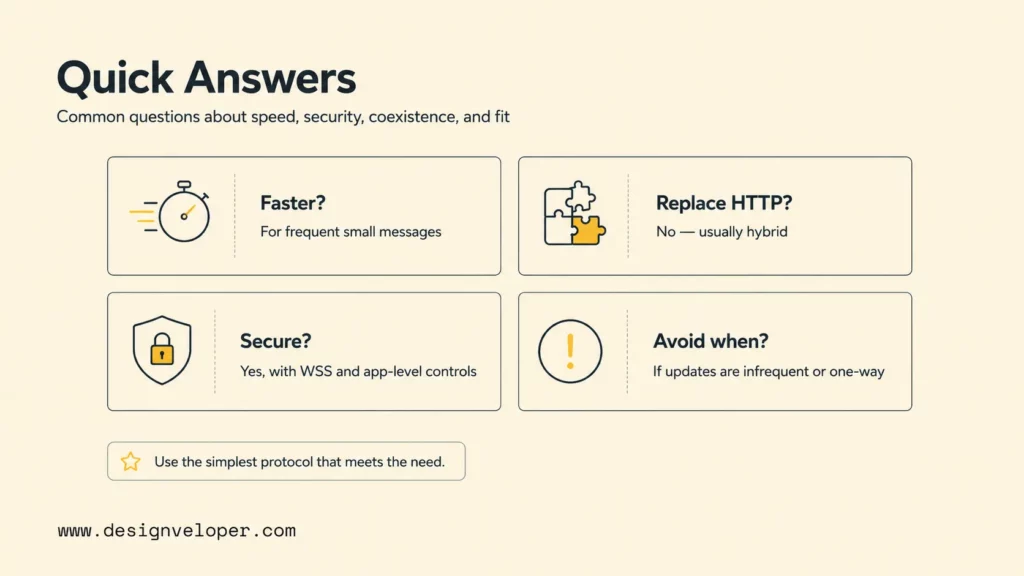
Is WebSocket Faster Than HTTP?
WebSocket can deliver frequent, small, bidirectional messages with less repeated protocol overhead after its handshake. That often improves responsiveness for chat, games, collaboration, and live dashboards. It is not universally faster. A cached HTTP response or an occasional API call may complete more efficiently without maintaining a persistent session. Network distance, server work, serialization, queueing, and rendering still determine end-to-end latency.
Does WebSocket Replace HTTP?
No. WebSocket begins with an HTTP-compatible handshake in common deployments and then switches to its own framed protocol. Applications still need HTTP for pages, assets, cacheable data, standard APIs, uploads, and many authentication or recovery operations. A hybrid architecture is more common and usually clearer than trying to move every operation onto WebSocket.
Is WebSocket Secure?
It can be secure when deployed with wss://, strong authentication, browser origin validation, per-message authorization, schema validation, rate limits, size limits, and careful logging. TLS protects data in transit, but it does not decide which channels a user may join or which commands they may send. Those controls belong to the application.
Can WebSocket And HTTP Work Together?
Yes, and they often should. HTTP can load initial state, perform CRUD operations, upload files, and recover snapshots. WebSocket can then deliver presence, notifications, live changes, or interactive streams. Clear ownership prevents duplicate business logic and gives the application a reliable recovery path when the live connection is unavailable.
When Should A Web App Avoid WebSocket?
A web app should avoid WebSocket when updates are infrequent, communication is mostly ordinary request-response, data benefits from HTTP caching, or the team cannot yet operate long-lived stateful connections reliably. It should also consider Server-Sent Events or HTTP streaming when updates primarily travel from server to browser. The simplest protocol that meets the user experience and reliability target is usually the best choice.
Also published on

Share post on









Related Articles


How To Choose A Web Hosting Provider: Key Factors To Consider
How To Choose A Web Hosting Provider: Key Factors To Consider Published August 05, 2026
WebSocket Protocol Vs HTTP: Differences, Use Cases, And Tips
WebSocket Protocol Vs HTTP: Differences, Use Cases, And Tips Published August 05, 2026
How 5G Impacts Mobile App Development: Opportunities and Challenges
How 5G Impacts Mobile App Development: Opportunities and Challenges Published December 11, 2025